Here's a question for you: when was the last time you asked ChatGPT something instead of Googling it?
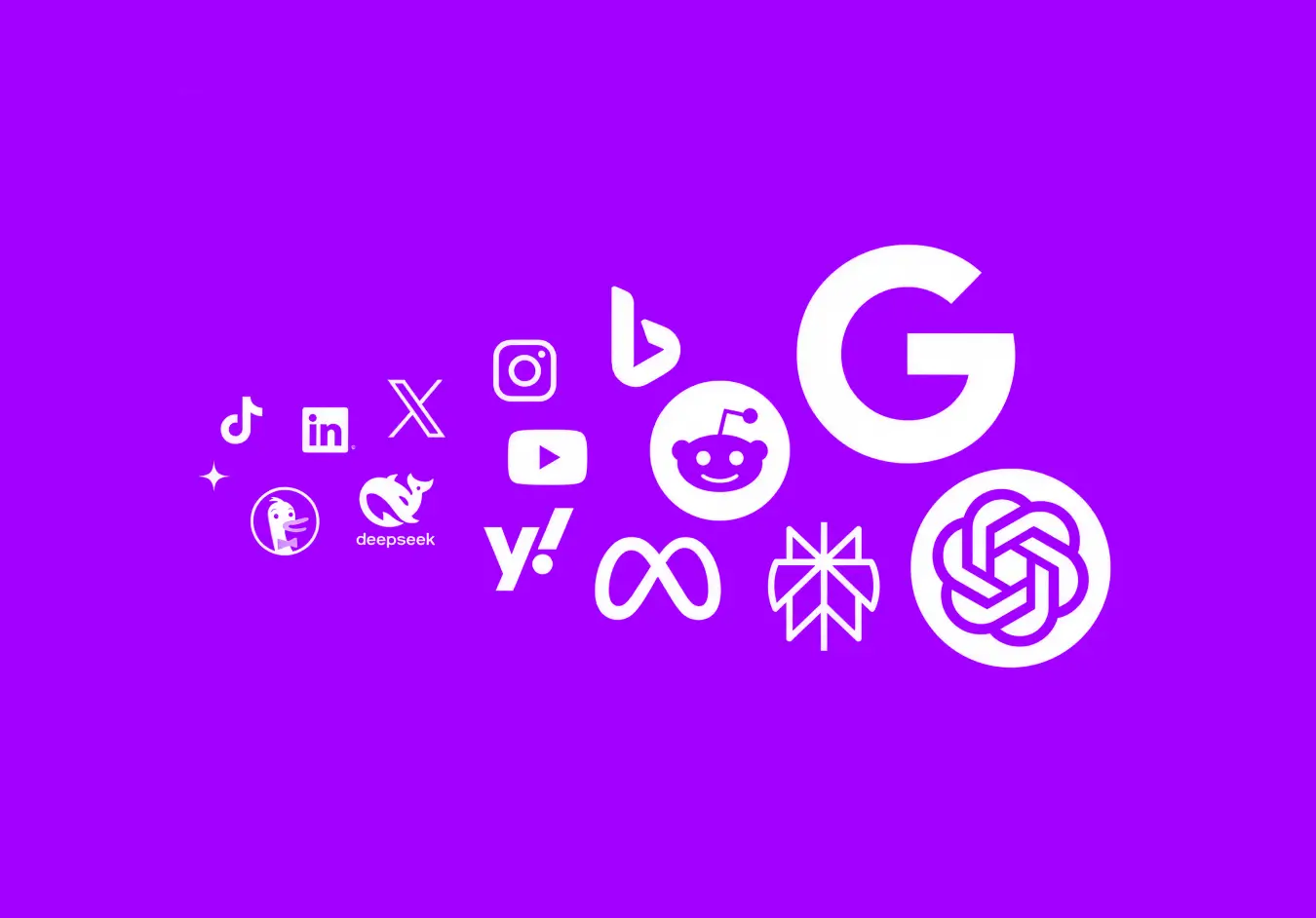
If you're like most people, it's probably more recent than you think. And that's the thing – search isn't just Google anymore. It's ChatGPT, Claude, Perplexity, and whatever AI tool launches next month. People are getting their answers from AI, and if your brand isn't showing up there, you've got a problem.
Let me explain why this matters, and more importantly, what you can do about it.
The way people search is changing (fast)
For years, search was simple. Someone types something into Google. Google shows a list of links. Person clicks one. Job done.
But now? People are typing questions into ChatGPT and getting full answers. They're asking Perplexity for recommendations and getting detailed explanations with sources. They're using Claude to research topics and make decisions.
And here's the kicker: they're not clicking through to websites anymore. They're getting what they need right there in the chat.
According to recent data, millions of people are using AI chatbots daily instead of traditional search engines. And that number is growing. Fast.
What this means for your brand
If someone asks ChatGPT "what's the best project management tool for small creative agencies?" and your tool doesn't get mentioned, you've just lost a potential customer. They'll never even know you exist.
If someone asks Perplexity "who are the leading sustainability consultants in the UK?" and you don't come up, that's a missed opportunity. Your competitor who does show up just got the enquiry instead.
This isn't theoretical. This is happening right now. Every single day.
The brands that adapt to this shift will thrive. The ones that don't? Well, they'll be wondering why their website traffic is dropping and where all their leads went.
But Google still matters (obviously)
Before anyone panics – yes, Google is still massive. It's still the biggest search engine by a country mile. Most people still start there.
But here's what's changed: Google itself is now using AI to answer questions. Those AI Overviews at the top of search results? That's Google's AI pulling information from websites and presenting it directly.
So whether someone's using Google, ChatGPT, or any other tool, the principle is the same: if you're not visible to AI, you're becoming invisible full stop.
You need to win in both places. Traditional search AND AI. Not one or the other.
How AI decides what to mention
Here's where it gets interesting. AI tools don't rank websites the same way Google does. They're looking at different signals.
When an AI tool answers a question, it's pulling from its training data and, increasingly, from live searches across the web. It's trying to give accurate, helpful information. And it tends to mention brands that:
Are genuinely authoritative – If multiple credible sources mention you as a leader in your space, AI notices.
Have clear, helpful content – AI tools love content that directly answers questions. The more useful and detailed your content, the better.
Get talked about – Mentions on Reddit, industry forums, news sites, and social media all contribute to your visibility. AI is trained on this stuff.
Are well-structured – Content that's easy for machines to understand gets cited more often. That means proper formatting, clear information, and good technical foundations.
Have a strong brand presence – The more cohesive your brand identity across the web, the more likely AI is to recognise and mention you.
The brands that are getting this right
Some companies are already ahead of the curve. They're showing up in AI responses because they've built their content strategy around being genuinely helpful, not just ranking for keywords.
They're active in communities where their audience hangs out. They're creating content that answers real questions in depth. They're building authority through PR, partnerships, and thought leadership. They're making sure their website and content are structured in ways that both humans and AI can understand.
And it's working. When someone asks an AI tool about their industry, they're the ones getting mentioned.
What happens if you ignore this
Let's be blunt about what's at stake here.
If you're only focused on traditional SEO, you're optimising for a search behaviour that's slowly declining. Your traffic might look okay now, but in 12 months? 24 months? You could be in trouble.
Younger audiences especially are starting with AI tools, not Google. If you're trying to reach them and you're not visible on the platforms they use, you simply won't exist in their world.
Your competitors who do embrace this will eat your lunch. They'll be the ones getting mentioned when people ask for recommendations. They'll be the ones building trust with potential customers before those customers even visit a website.
How to actually get visible on AI
Right, enough doom and gloom. Let's talk about what you can actually do.
Create genuinely helpful content. Not content stuffed with keywords. Content that actually answers the questions your audience is asking. In depth. With expertise.
Build authority beyond your website. Get mentioned in industry publications. Contribute to conversations on Reddit and other forums (authentically, not spammy). Build partnerships and get cited by credible sources.
Structure your content properly. Use schema markup. Organise information logically. Make it easy for both humans and AI to understand what you do and why you're good at it.
Be active where your audience is. If your customers are on LinkedIn, be there. If they're in specific subreddits, engage there. AI is trained on publicly available data – be part of those conversations.
Focus on E-E-A-T (Experience, Expertise, Authoritativeness, Trust). This matters for Google AND AI. Demonstrate your expertise. Show your experience. Build trust.
Monitor your AI visibility. Regularly check if your brand comes up when people ask AI tools questions about your industry. If not, you've got work to do.
Think about the full journey. Someone might discover you through AI, then check your website, then look at your social proof. Every touchpoint needs to be solid.
This is about being discovrd everywhere
This is exactly what we mean when we talk about getting "Discovrd". It's not just about ranking on Google anymore. It's about being visible and credible wherever people are looking for information.
Whether that's:
- Google's traditional search results
- AI Overviews in Google
- ChatGPT when someone asks for recommendations
- Perplexity when someone's doing research
- Reddit when someone's asking their community
- YouTube when someone's watching video content
- Social platforms when someone's scrolling
You need to show up. And not just show up – show up as the credible, authoritative option.
The opportunity is now
Here's the good news: most brands haven't figured this out yet. They're still solely focused on traditional SEO. Which means if you move now, you've got a head start.
The brands that understand AI visibility now will be the established authorities by the time everyone else catches up. They'll be the ones AI tools mention first. The ones with the reputation. The ones winning the business.
It's not either/or, it's both
Just to be crystal clear: this isn't about abandoning traditional SEO. Google isn't going anywhere. You absolutely still need to rank there.
But you also need to recognise that search behaviour is evolving. People are finding information in new ways. And if you're not visible in those new ways, you're going to struggle.
The smartest approach is to build a strategy that works across all discovery channels. Traditional search, AI tools, social platforms, community forums – everywhere your audience might look for what you offer.
That's what a proper modern search strategy looks like.
Let's make sure you're not invisible
If you're reading this thinking "I have no idea if we show up on AI tools" or "we're definitely not optimised for this", you're not alone. Most brands aren't.
But that doesn't mean you should stay in that position.
We can help you understand where you currently stand, where the opportunities are, and how to build visibility across both traditional search and AI. Because in 2025, you need both.
The way people discover brands is changing. The question is: will your brand be discovered?
Want to know how visible you are on AI tools? Let's run a Discovrd Blueprint and find out. Then we can build a plan to make sure you're showing up everywhere that matters.
Because being invisible on AI is the new page two of Google. And nobody wants to be there.